Project Highlights
Representative projects demonstrating systems analysis, process modeling, commissioning, technology development, and technical decision support across thermal and industrial energy systems.
District Heating System Strategy & Expansion Assessment
Summary
An existing biomass district heating network was evaluated to identify practical pathways for increasing system efficiency, reducing biomass demand, and eliminating reliance on external heat supply. The study assessed the interaction between network hydraulics, biomass boilers, flue gas condensation, absorption and compression heat pumps, thermal storage, and photovoltaic integration to support long-term investment planning.
Outcome
The systems analysis identified a technically feasible pathway towards 15–25% lower biomass consumption, €0.38–0.56 million annual economic benefit, and elimination of external peak heat supply through coordinated implementation of network optimization, flue gas condensation, heat pumps, and thermal storage.
Scope
District heating systems · Techno-economic analysis · Heat integration · System modeling · Decarbonization strategy · Investment decision support
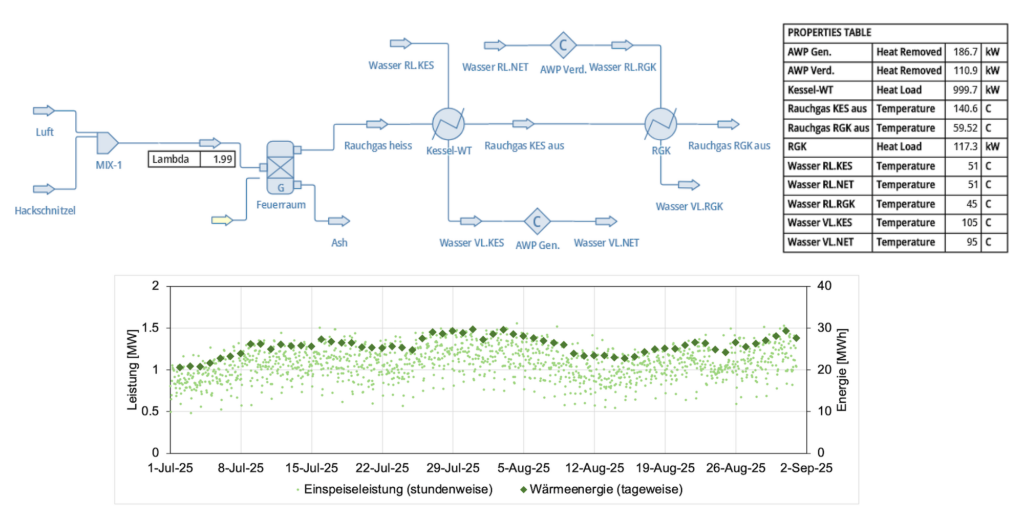
DWSIM process simulation and systems analysis supporting district heating expansion and decarbonization strategy development.
Paper Mill Expansion Strategy
Summary
An integrated paper mill was evaluating how to expand production while reducing long-term energy costs and emissions. A site-wide energy system model was developed to compare continued use of the existing natural-gas combined-cycle (NGCC) infrastructure against a new circulating fluidized bed (CFB) boiler.
Outcome
The analysis showed that maintaining the existing NGCC system for the planned production expansion would increase modeled operating costs by approximately 65% relative to the current operation. Replacing it with a 90 MWth CFB boiler instead enabled the expansion while reducing modeled operating costs by approximately 15% relative to the existing facility, providing a clear technical basis for investment planning.
Scope
Energy systems modeling · Boiler & steam cycle simulation · Retrofit feasibility · Fuel switching · Emissions assessment · Investment scenario analysis
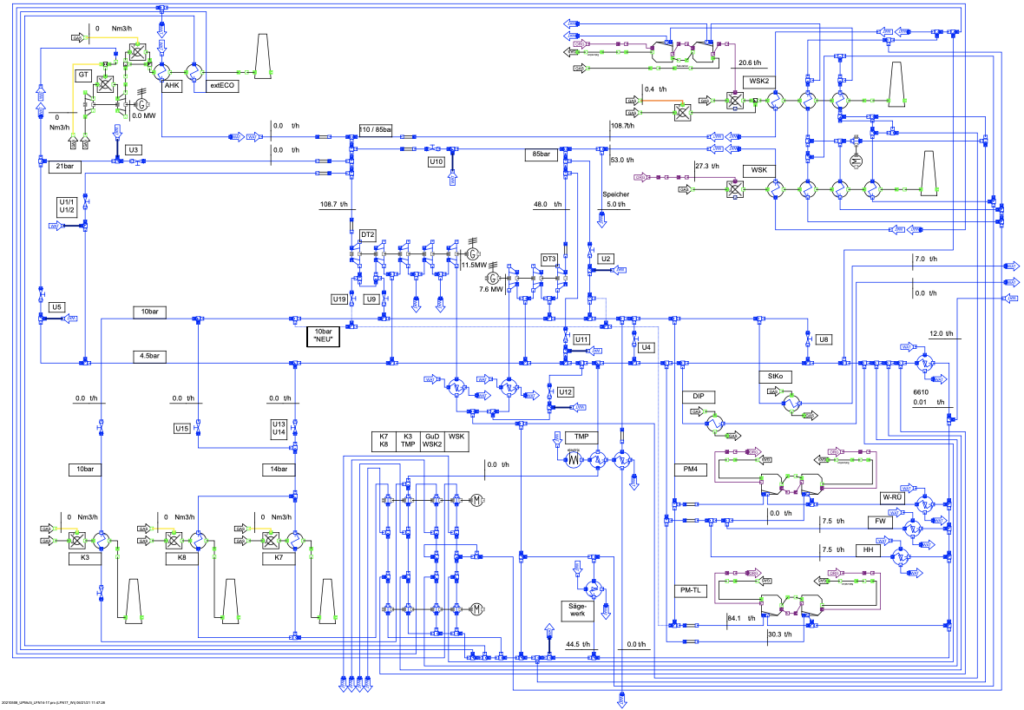
IPSEpro model developed to evaluate alternative paper mill expansion pathways.
Biomass Power Plant Development & Commissioning
Summary
Supported the construction and commissioning of a 40 MWth residual biomass power plant featuring a bubbling fluidized bed (BFB) boiler, steam cycle, auxiliary systems, and district heating integration. Served as a technical advisor throughout engineering, commissioning, and plant startup, helping bridge design intent with operational reality.
Outcome
Contributed to a smooth commissioning and startup by resolving technical issues across engineering disciplines, validating system functionality, and coordinating operators, vendors, and engineering teams. Moderated weekly LOP meetings and HAZOP studies to support structured project delivery.
Scope
Commissioning support · Plant startup · P&ID application · Auxiliary system integration · Acceptance testing · HAZOP moderation
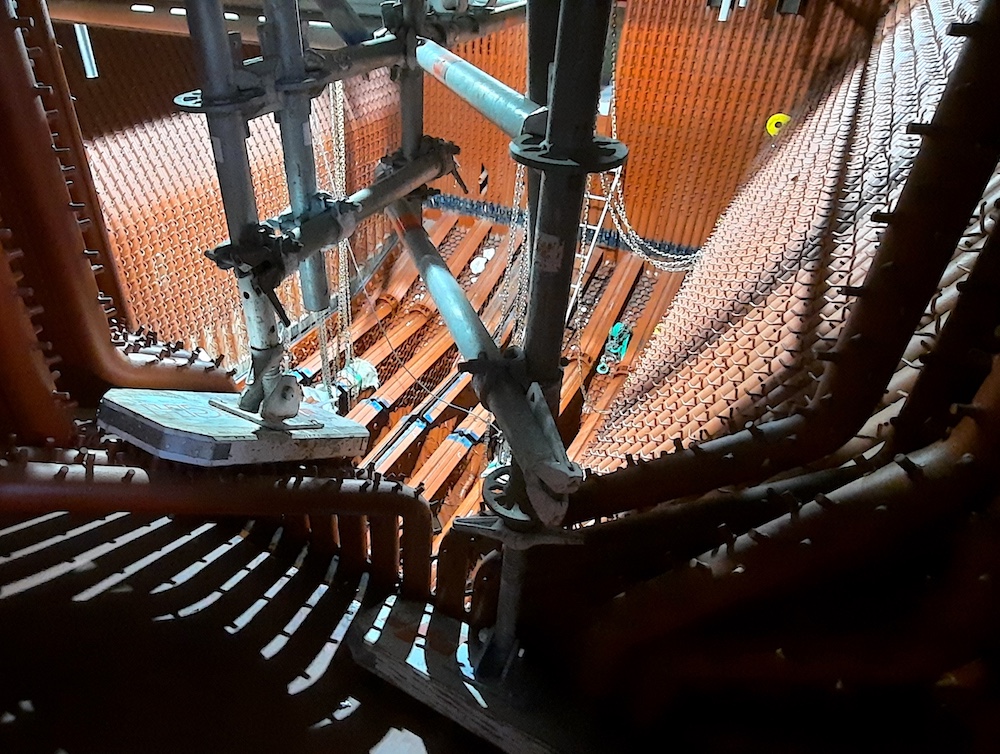
Inside the BFB boiler during construction and commissioning.
Shaft Kiln Modernization Strategy
Summary
A magnesite producer was evaluating modernization options for an existing shaft kiln to reduce fuel consumption, improve operational reliability, and justify capital investment. The work included the design of a solids preheater based on gas–solids heat transfer optimization, together with heat recovery, combustion optimization, and process integration.
Outcome
The proposed retrofit concept reduced modeled natural gas consumption by approximately 20%, corresponding to annual energy cost savings exceeding €0.3 million, while reducing CO2 emissions by 15–20%. The study also quantified investment requirements and demonstrated a projected payback period of approximately 2.5 years.
Scope
Gas–solids heat transfer · Process integration · Heat recovery · Combustion optimization · Techno-economic evaluation · Retrofit strategy
Optimization of Domestic Hot Water Systems
Summary
Developed and field-validated a low-cost retrofit strategy for domestic hot water (DHW) circulation systems in existing residential buildings. The work introduced a simple temperature- and timer-based pump control concept to reduce circulation losses without modifying the existing hydraulic infrastructure.
Outcome
Field measurements demonstrated 20–30% reductions in circulation heat loss and 15–20% primary energy savings while maintaining user comfort and complying with DHW hygiene requirements. The approach proved readily transferable to existing residential building stock through minimal retrofit effort, and required only inexpensive control modifications while avoiding changes to the existing pipework and hydraulic system.
Scope
Building energy systems · DHW circulation control · Field measurements · Experimental validation · Low-cost retrofit strategies
Resource
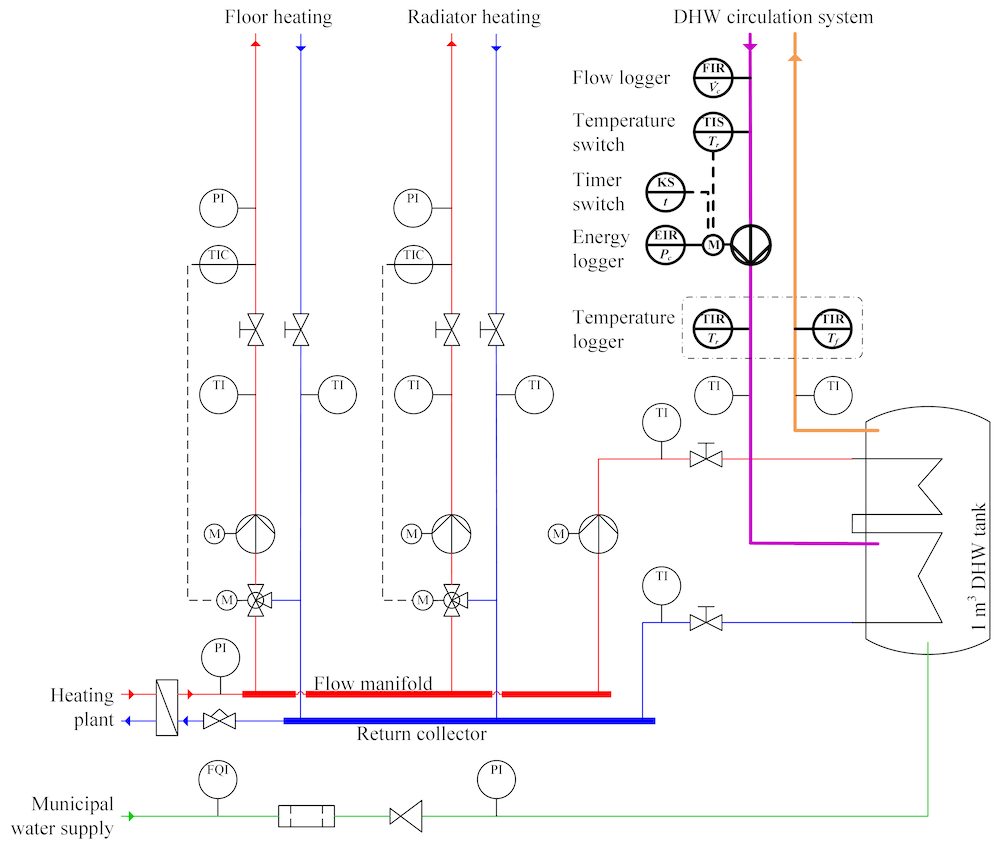
Schematic of the DHW system with the proposed temperature- and timer-based pump control strategy.
ViennaGreenCO2 – Solid Sorbent Carbon Capture
Summary
Contributed to the development of the ViennaGreenCO2 pilot plant for continuous temperature swing adsorption (TSA) post-combustion carbon capture. Led the experimental development of fluidized-bed heat transfer and particle mixing, helping address one of the key engineering challenges in scaling continuous solid sorbent carbon capture.
Outcome
Co-designed and commissioned an experimental facility used to characterize heat transfer and fluidized bed hydrodynamics, providing design data for the ViennaGreenCO2 pilot plant. The resulting technology successfully demonstrated >900 hours of pilot operation and advanced TSA from TRL 4 to TRL 6.
Scope
Experimental reactor design · Fluidized-bed heat transfer · Particle mixing · Bench-to-pilot scale-up · Process validation
Resource
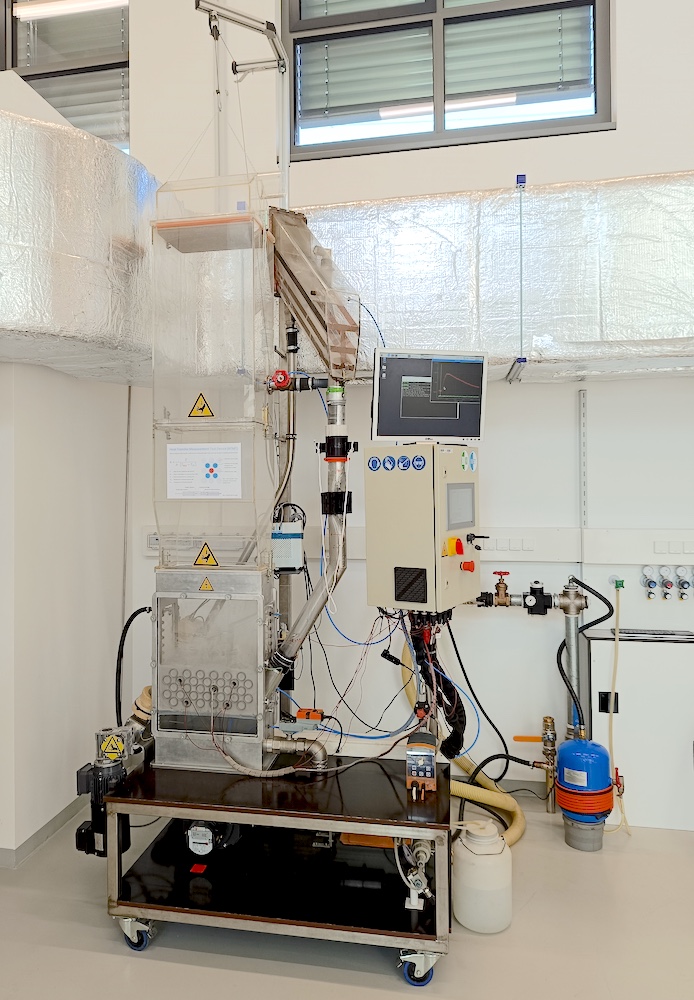
Custom-built fluidized-bed test rig for investigating heat transfer and particle mixing.